

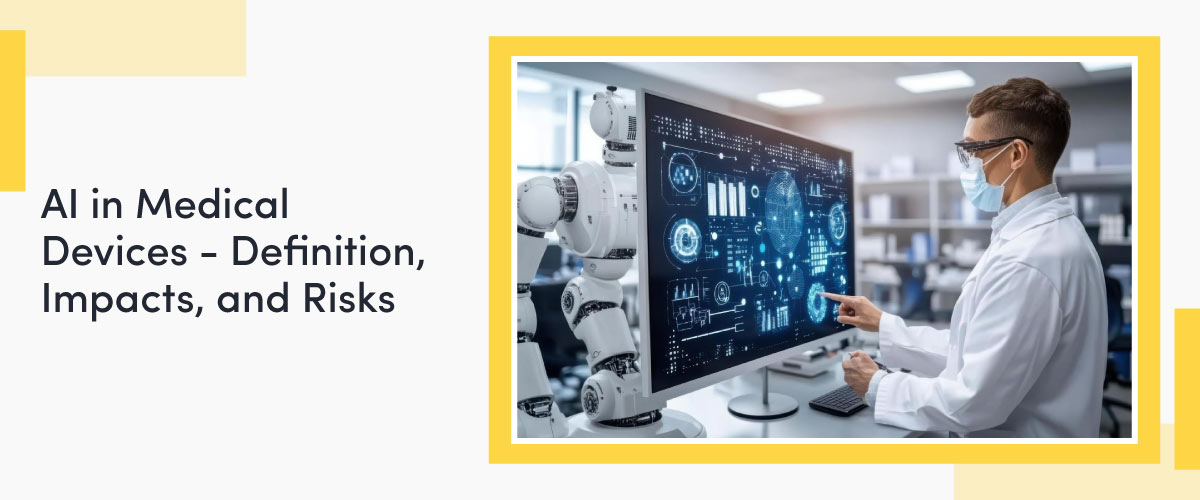
AI in medical devices means faster diagnostics, real-time monitoring, predictive care, and better clinical decisions, combining to drive efficient, patient-centred care. Given the rapid evolution of technology, integrating AI into medical devices requires thoughtful design, sound regulatory alignment, and a human-centred approach. As AI continues to redefine healthcare, the role, impact, and challenges of the times ahead need to be reiterated among innovators, clinicians, and device manufacturers.
In a nutshell, AI is changing healthcare worldwide. Let’s explore how.
What Is Artificial Intelligence in Medical Devices?
AI in medical devices includes software-run systems processing copious volumes of medical data, the recognition of patterns, and further clinical decisions with or without human interference. Pairing intelligent algorithms with medical hardware, AI devices help enhance accuracy, speed, and reliability in delivering care. These devices can perform image recognition, real-time patient monitoring, predictive analytics, diagnosis, and anomaly detection.
The relevant examples include AI-powered ECG monitors, radiology tools identifying tumours and fractures, and wearables that track vital signs.
In a nutshell, AI medical devices are one of the critical enabling technologies for the next wave of medical innovation.
The Impact of AI on Modern Medical Devices
1. Enhanced Diagnostic Accuracy
Artificial intelligence-backed medical devices have much higher diagnostic precision. This means AI imaging platforms can catch early problems faster and more precisely than humans sometimes can. Such solutions are evolving the future of radiology, oncology, cardiology, and ophthalmology. Consequently, this improves patient outcomes, and diagnostic errors drop, making AI in medical devices a staple in today’s clinical workflows.
2. Personalised and Predictive Healthcare
AI systems analyse individual patient data to tailor treatments and forecast health risks. Wearable biosensors are able to continuously monitor glucose, heart rhythms, oxygen levels, or stress. These AI devices have ergonomic, user-friendly designs that provide comfort, assurance of adherence, and seamless feedback loops. To make this happen, product teams blend sensors, software, and UI in ways that deliver real-time insights without overwhelming users. However, the role of a product design company is highly crucial; that’s why many companies partner with expert product design services like Criador Labs.
3. Operational Efficiency in Healthcare Systems
Intelligent AI-driven devices now automate data entry, simplify workflows, and reduce clinician fatigue by performing repetitive tasks. Systems that integrate with EHRs, enable remote monitoring, and provide decision support and add value for hospitals. In contemporary times, ease of interface and interoperability are becoming important factors in the development of AI-based medical devices.
4. Data-Driven Innovation in Product Design
AI-generated insights help manufacturers fine-tune performance and anticipate what users need. This speeds up development and boosts usability. Many companies team up with specialised design agencies that leverage AI feedback to speed up prototyping and optimise the user experience. Partnering with a medical device development company, like Criador Labs, ensures that design, engineering, and AI capabilities align for innovation.
Key Risks and Challenges of AI Medical Devices
1. Ethical and Regulatory Complexity
Rules around AI medical devices are constantly changing. There must be a balance between safety, transparency, and consistency because models change continuously. Agencies, such as the FDA and the EU MDR, have begun to set standards to test self-learning programmes and have control over them.
2. Data Privacy and Security Risks
AI requires vast reams of data, thus posing a complicated question concerning privacy and cybersecurity. Designers must use strong encryption and handle data with due ethics while setting very clear, transparent rules for compliance to protect patient information. Clarity about how data is used builds trust.
3. Algorithmic Bias and Reliability Issues
AI can treat people differently if it’s trained on biased or incomplete data. Wide representation, ongoing checks, and human supervision are needed to make AI medical devices reliable.
4. Human-Centred Design Limitations
The results of AI aren’t intuitive; they’re important for doctors or confusing for patients. Designers focus on simple, clear interactions. A balance between powerful AI and a friendly, trustworthy interface is needed from the team. See more in Medical Device Development Process.
The Role of Product Design in AI-Driven Medical Innovation
1. Human-Centred Development
Empathy, usability, and accessibility are the birth givers of great AI medical devices. Designers turn complex AI into clear, easy-to-use interfaces that help clinicians make confident choices.
2. Collaborative Design Between Engineers and Clinicians
Working across design disciplines ensures that AI outputs meet actual clinical needs. Prototyping, usability testing, and validation in product design are important steps to make AI safe and effective in medical devices.
3. Sustainable and Ethical Innovation
Design teams consider long-term ethics, data use, upgrade paths and how the device will be maintained throughout its life. An ethical, transparent design helps set a device apart in the medical field. For more about the value of design, see Why Invest in Good Product Design?
Conclusion
As AI continues to advance in healthcare, putting it into medical devices can make care safer, quicker, and more personal. Yet it requires thoughtful design, rule awareness, fair data, and a people-first approach. The future of AI in medical devices will result from combining smart technology with deep clinical insight and caring. Those manufacturers who carry out this mission well will drive the next waves of change in healthcare. With thoughtful design, ethical practices, and interprofessional collaboration, AI-based medical devices will continue to fuel modern medical innovation.
If you are ready to harness the power of AI and make a medical device that works beyond traditional medical devices, contact Criador Labs. We are the number one medical device design company in India.

Abhishek Reddy Gujjala
Criador Labs is an innovative product design studio that is future-focused and renowned for turning bold ideas into exquisitely engineered products. With expertise in Medical Devices, Consumer Technology, and Industrial IoT (Internet of Things), we combine strategy, design, and usability to deliver tangible creative solutions. Founded by Abhishek Reddy Gujjala, an entrepreneur passionate about purposeful innovation, Criador Labs reflects his vision of creating meaningful products that solve real-world problems through thoughtful design.
