

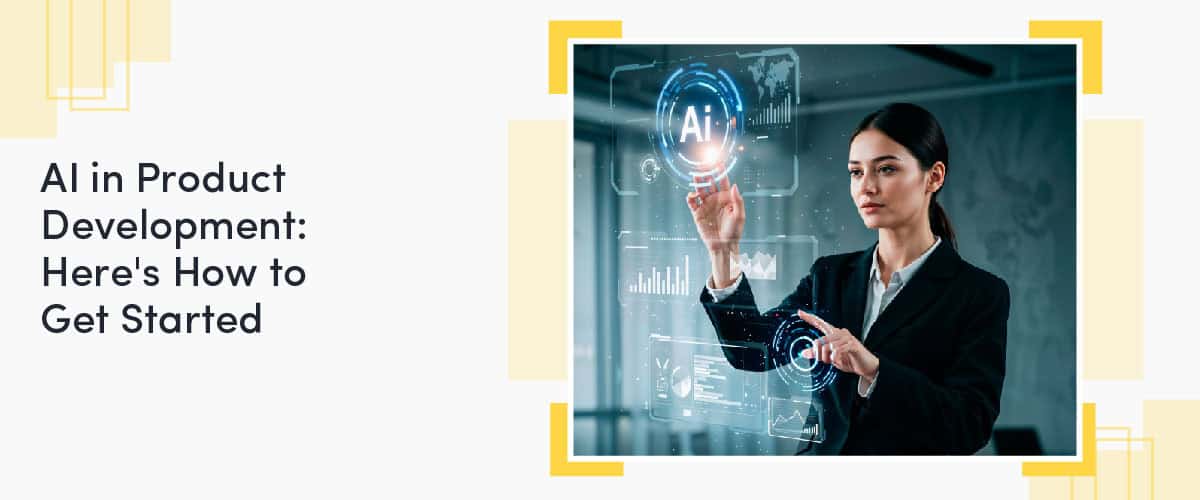
AI has become a potent ally for every industry by offering advanced and time-saving tools for automation, analysis, and optimisation. Product development is not untouched by it, allowing a variety of processes to be faster, error-free, and innovative like never before. To explain this transformation brought by AI in product development, we have curated this detailed blog post. So, continue reading and discover how AI is revolutionising product development processes.
Why AI Matters in Product Development?
Product development companies were consistently facing pressure in terms of generating new ideas and developing new products. To put the pressure off and match the speed and efficiency with contemporary demands, AI has been brought into product development. It is now seamlessly facilitating data analysis, idea generation, analysing customer data, simulating product testing, and automating processes to speed up time to market. It supports product development with faster decision-making, reduced risks, and improved efficiency.
To sharpen your knowledge about product design and development, read this detailed blog post: What is product design and development?
Key Applications of AI for Product Development
1. Market Research and Trend Prediction
Product development requires market research and trend prediction based on the data. AI is making these frontline tasks of product development easier by quickly generating actionable suggestions and accelerating market research and trend forecasting. It is also helping businesses design relevant products by analysing large datasets to identify consumer behaviour and forecast demand.
2. Product Design Optimisation
AI can generate tons of design suggestions based on the provided parameters (usually goals and constraints). It helps designers to analyse multiple design variations and even test them virtually through AI-powered simulations. With AI, designer can enhance their design with data-driven decisions by feeding AI models a set of data related to the product.
3. Prototyping and Testing
Prototyping and testing in product development allow designers to visualise the idea and concept. AI helps in this phase by speeding up the iteration process and suggesting more design variations to counter design flaws. It allows stakeholders to save time and cost in early development stages.
4. Manufacturing and Production Efficiency
AI is being heavily used in product development to offer a new dimension to manufacturing and production efficiency. AI monitors assembly lines, predicts manufacturing failures and ensures quality controls, saving time and reducing cost. It automates several repetitive tasks, like design iterations, which reduces manual involvement in manufacturing and thus enhances production efficiency.
5. Customer Feedback and Post-Launch Improvement
AI analyses reviews and user feedback, offering suggestions based on the feedback data to improve the product even after the launch. It ensures the product stays relevant and useful for its users.
Benefits of Using AI in Product Development
Let’s explore how AI is benefiting product development through its efficient and error-free technology integration.
- Faster Time-To-Market: AI speeds up all processes involved in product development, be it wireframing, prototyping, or development, and drastically decreases the time to market.
- Reduced Costs: AI reduces the cost of product development through smarter testing and resource allocation. It also helps engineers maintain the operational cost by predicting maintenance requirements.
- Better Alignment With Consumer Needs: AI in product development analyses vast customer data to identify preferences, personalises product features, and predicts market demands. It leads to better alignment with consumer needs.
- More Innovative and Competitive Products: AI accelerates development cycles, designs, and iterations to create a roadmap for something new, leading to the development of innovative and competitive products.
Challenges of AI Product Development
The major challenges of AI-powered product development are related to data issues, which are divided into three categories. First is the availability of data, second is the quality of data, and last is the unbiasedness of data. First of all, there should be the data available around the product concept to refine the whole idea through AI. Secondly, the quality of data also determines the quality of the product. And last but not least, if the fed data is biased, expect AI to produce biased results, leading to unfair and unethical products.
How to Get Started with AI in Product Development
1. Identify Business Needs
To get started with an AI-powered product development, you need to first identify the business needs, as AI can only add strategic value to the goal. Ensure you collect unbiased data around your chosen idea and make a strategy to guide your AI-driven product development. Also, pinpoint the area where you can massively leverage the AI and thus design a product that stands out.
2. Choose the Right Tools and Platform
After identifying the need, deciding goals, and collecting quality data, it is time to select the right AI tools and platforms. It involves selecting those tools and platforms that come out clean on use case, data, budget, and the team’s technical skills. Also, make sure tools are easily accessible and user-friendly for hassle-free design, testing, and production applications.
3. Build a Skilled Team
Now, you need a team that has skill sets aligned with the goal. You can also collaborate with data scientists, engineers, and product managers to infuse expert-backed product strategies into the roadmap and decisions. If they are not feasible for you, the best option would be to opt for product development services and let them handle all the product development stressors. At the same time, you relax in your comfortable place. Best and easy!
4. Start Small, Scale Later
Before integrating AI-powered systems across the organisation, start with a pilot test and see how things go. If things seem smooth and productive, gradually integrate AI into your organisation and ensure integration moves in a phased manner to eliminate interruption of ongoing developments.
Also Read: The Phases of Product Design and Development
Conclusion
By now, we have understood how AI is revolutionising product development with its speedy, time-saving, and data-backed suggestion approaches. To fast-track your product development and walk in step with time, ensure you leverage AI to make your product more relevant and customer-friendly.
Criador Labs is a renowned and innovative product and medical device development company. We are known for developing high-quality and customer-friendly products that are not only loved by customers but also bring sustainable revenue for you. So, what are you waiting for? Bring your idea and let us help you build a product that shines. Contact us today!

Abhishek Reddy Gujjala
Criador Labs is an innovative product design studio that is future-focused and renowned for turning bold ideas into exquisitely engineered products. With expertise in Medical Devices, Consumer Technology, and Industrial IoT (Internet of Things), we combine strategy, design, and usability to deliver tangible creative solutions. Founded by Abhishek Reddy Gujjala, an entrepreneur passionate about purposeful innovation, Criador Labs reflects his vision of creating meaningful products that solve real-world problems through thoughtful design.
